
People Strategy
People Strategy defines, Talent Management delivers.
Chances are your organisation has a well-defined business strategy. It is quite likely that it has been shared among your employees and probably even published in your annual report. But what about your organisations’ people strategy? You won’t find that in any annual reports and probably not in any internal documents either. If you ask the leadership team in most companies you will get either a blank look or directions down the hall to ask HR. Yet these same executives will all agree, “people are our most important asset”.
This isn’t really that surprising. Thirty years ago Michael Porter was working on a book to follow his “Competitive Strategy” and CEO’s everywhere were agreeing that they must define their business strategy. But you wouldn’t have found any published strategy statements and most organisations would have struggled to articulate their strategy, even within the boardroom.
A defined people strategy is the logical extension of the business strategy. It lays out how the organisation intends to utilize its most important asset to deliver on its objectives. It is not subservient to the business strategy. When used properly, the people strategy informs the business strategy, helping executives to decide what the best approach will be for the organisation. Both flow from the corporate objectives and work together to enable the organisation to deliver.
Just as with corporate strategies, the people strategy changes as the business develops and the key challenges evolve. Local businesses are unlikely to define their organisational culture. It is often an extension of the founder principle leader’s own approach and values. But as a business expands its territory, so the span of control stretches and it becomes necessary to articulate the culture through standards and value statements. Overseas growth introduces new employees with potentially very different backgrounds and approaches. The people strategy may need to find ways to impose the corporate culture to ensure that control is maintained by the original organisation. When an organisation becomes truly global it begins to embrace the different cultures and the people strategy again shifts to one of inclusion.
The people resource begins with an understanding of the capabilities of the organisation. Are we an innovative organisation or are we better at systematising processes? Are our people good at fundamental research or are we better at exploiting developed ideas? The answers to such questions supports strategic decision-making. If we are not capable in a particular area, is it better to accept that and focus on our strengths, or take the time and energy to build that capability? And so the business strategy in turn influences the people strategy.
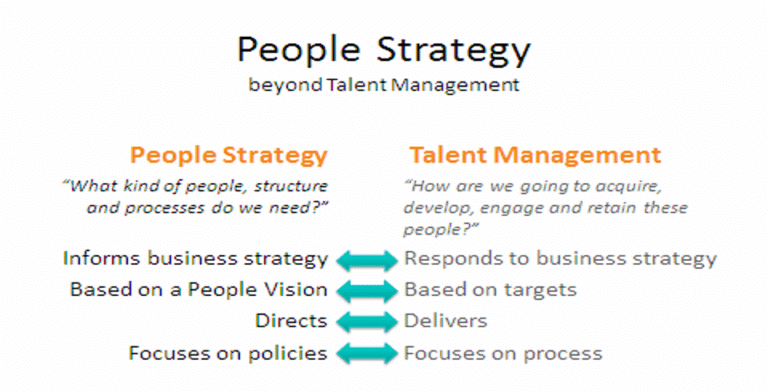
Creating a cohesive and robust people strategy is a complex process; there is no single right way to do it as each and every organisation has a unique strategy, capability set, structure and culture – all of which play a role in shaping the most appropriate strategy for the company. What is clear is that HR cannot have these discussions in seclusion. The Leadership Team must be fully engaged in the process and must own the outcome.
The following considerations are taken into account when devising a people strategy:
Company Mission
A statement of the leader’s view of the purpose and direction of the organisation. It describes the business that the company leaders want to be in for the next 5-20 years, the purpose for which the organisation exists and the main assets by which it will be fulfilled.
Corporate Objectives
These are set out as the outcomes that the organisation is trying to achieve in the next year. These are stated in a way that allows them to be measured and therefore as to how well they have been achieved.
Business Strategy
What strategic direction is the company following which will ensure the objectives are achieved?
Corporate Capability
What capabilities exist in the company to execute the strategy both now and in the future?
Company Culture
The culture of the organisation is the shared set of attitudes, values and beliefs which determine the way decisions are made and implemented.
Organisation Structure
What is the most appropriate organisational structure which will allow the company to make the most of the people and thereby to function most effectively?
The People resource
What are the measures of the people in the organisation at the individual and team level which define the talent resource.
The Talent Management Strategy
This defines how the organisation can best recruit, monitor, support, develop and promote their people to deliver the corporate strategy.
Each area has to be reviewed at the organisational, team and individual level to create a cohesive approach that is specific enough to provide guidance, yet flexible enough to cope with change.
Just as with a corporate strategy, the people strategy will need to be reviewed over time to ensure that it is still relevant to the organisation and its environment. If this process becomes an intrinsic part of the organisation’s strategy development, then the people strategy will begin to inform the overall strategy, rather than having to react to it.
If you would like to discuss how we can facilitate the development of your people strategy, or wish to find out more about our services, please get in touch by email or phone.
About hfi
hfi is an established Business Psychology Consultancy that specialises in talent management all over the world. Our distinctive competency and competitive advantage is a deep and extensive knowledge of psychology coupled with experienced understanding of any given business environment. For over 30 years hfi has used the science of psychology and in-depth business knowledge to identify talent and release the potential of global companies to create wealth through people.