
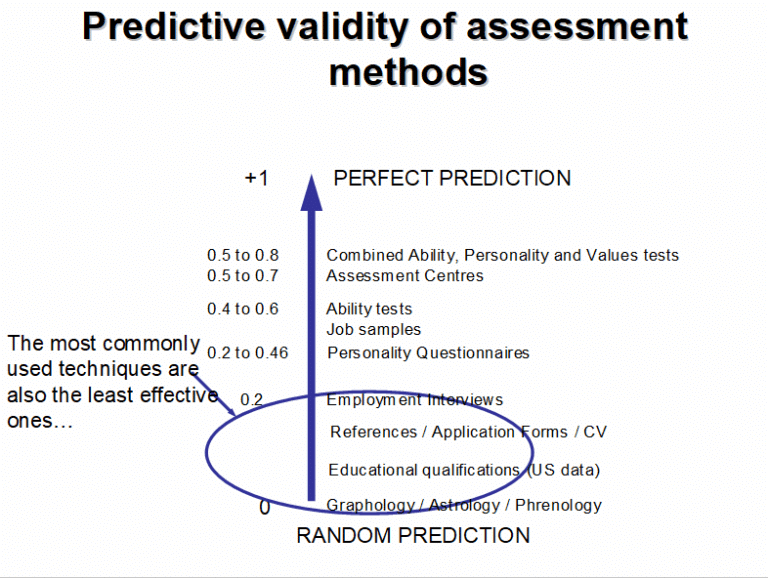
Predictive validity of Assessments Methods
Psychometrics
The most significant area of change within assessment research has been the increased confidence in the validity of most selection methods through meta-analytic studies. Meta-analytic studies of a wide variety of assessment methods have indicated that when man-made effects of sampling error, range restriction and measurement unreliability are removed, the ‘true’ validity of psychometric assessments is higher than originally thought. Psychometric assessment is useful for selecting individuals for job roles and also for personal development.
General Mental Ability Tests
Despite continual attempts to downplay the importance of general mental ability tests, research shows time and again that general ability test scores predict performance. This is not surprising since general ability is essentially identifying an individual’s ability to learn and make sense of their environment. General ability is most effectively assessed by the use of a well designed and validated general ability test.
Emotional and Social Intelligence
Emotional Intelligence and the more recently propounded Social Intelligence are not new concepts. They were originally described by Thorndike in the 1920s in his tripartite theory of intelligence. Although proponents of emotional and social intelligence claim that these intelligences are more important for success in managerial roles than general ability, scores on emotional and social intelligence are significantly correlated with general ability scores. Emotional and Social intelligence are essentially interpersonal and personal skills or competencies. As such they can be learned. Consequently, it is not surprising that they are correlated with general ability since general ability is the capacity to learn. People with higher general mental ability are likely to be faster and more adept at understanding complex concepts and relationships. Understanding the social, emotional and cultural context is a very complex business.
Potential for Emotional and Social Intelligence can be inferred from a combination of personality, values and general ability testing. However, since these are learned skills or competencies, the extent of the individuals current skill can only be observed through behaviourally based assessment such as interactive exercises – group discussions, role plays, situational judgment exercises, structured competency based interviews. The extent of current skill in these areas can also be identified through a 360 degree feedback assessment. Emotional and social intelligence can be developed through coaching and experiential training.
Assessment and Development Centres
There has been concern recently among psychologists about which constructs are measured by Assessment Centres. Studies using factor analysis indicate that the key aspects which arise from analysis relate strongly to the exercises performed rather than to the competencies which are meant to be assessed. Hough and Oswald (2000) have suggested several features which may improve the ratings and psychometric quality of Assessment Centres for example using several psychology-trained assessors, having only a few conceptually distinct constructs or using cross-exercise assessment. Scholz and Schuler (1993) conducted a meta-analysis of Assessment Centre data which attempted to explore the key constructs measured in the overall assessment rating. They found that overall assessment rating to be highly correlated with general intelligence (0.43), achievement motivation (0.4), social competence (0.41), self-confidence (0.32) and dominance (0.3). These results suggest that the primary construct measured within Assessment Centres is mental ability.
When well designed, Assessment Centres can identify an individual’s current level of skill and development needs. When combined with psychometric assessment they provide strong predictive validity. However, they are costly and time consuming so their usefulness should be continually reviewed.
Some ideas for improving Development Centres
- Be clear if the centre objective is assessment or development. Although the exercises might be similar, the methodology is quite different and so is the participants’ reaction.
- Design the development centre as a simulation. Use real data from the organization and simulate the real demands of the job. Off the shelf exercises are poorer predictors of performance. Exercises afford the most valid results when they most closely resemble the job that the participants will be expected to do.
- Do less and achieve more – five well-constructed exercises with sufficient time to reflect and discuss will provide a better result than ten rushed exercises that provide no time for reviewing the learning. This is particularly useful in Development Centres where the emphasis is on self-awareness. Observers can see how well people are able to analyse their own performance and learn from their mistakes.
- Add a 360 degree feedback. Development Centres are somewhat removed from the real world of everyday stresses. 360 addresses these limitations.
- Get the participants to do more. Get them involved in assessing their own behaviour, writing reports on themselves (with some supervision!). This frees up observers and facilitators to add more value through feedback and coaching.
- Provide feedback throughout. The most helpful feedback comes in small doses as soon after the event as possible. Feedback after each exercise accompanied by the time to absorb and think through the implications is the most useful.
- Use the assessment/development centre sparingly. They are expensive, complex and time consuming. Use them only when easier and cheaper alternatives such as 360 degree, psychometric assessment are not enough.
- Provide a participant log book in which they can record what they learned, what they thought, how they felt.
- Start with career planning. Before the Centre, get people to think about their long term career plans. Then they see the relevance of the centre and their attitude to it is likely to be more positive.
- Focus on strengths. Make the aim of the development centre to discover and foster strengths rather than come out with a list of development needs i.e. weaknesses. Put the effort into finding ways in which the organisation can utilize individual’s strengths rather than trying to get everyone up to a certain level in all things.
References:
Bobko, P. Roth, P.L. and Potosky, D. (1999) Derivation and implications of a meta-analytic matrix incorporating cognitive ability, alternative predictors, and job performance. Personnel Psychology, 52, 1-31.
Goleman, D. (1996) Emotional Intelligence. London. Bloomsbury.
Hough, L.M. and Oswald F.L. (2000) Personnel Selection: looking toward the future – remembering the past. Annual Review of Psychology, 51, 631-644.
Hunter, J.E. and Schmidt, F.L. (1990) Methods of meta-analysis: correcting error and bias in research findings. Newbury Park, CA: Sage.
Lee,G. (2003) Same old Development Centres. Selection and Development Review 19(5)
Linley, P.A and Harrington, S. (2005) Selection and Development: a new perspective on some old problems. Selection and Development Review 21(5)
Linley, P.A and Harrington, S. (2006) Playing to your strengths. The Psychologist .
Scholtz, G., and Schuler, H. (1993) The nomological network of the assessment centre: a meta-analysis. Zeitschrift fur Arbets und Organizationpsychologie, 37, 73-85.
Shakleton, V. and Newell, S. (1997) International assessment and selection. In N. Anderson and P. Herriot (Eds), International Handbook of selection and assessment. Chichester, UK: Wiley.